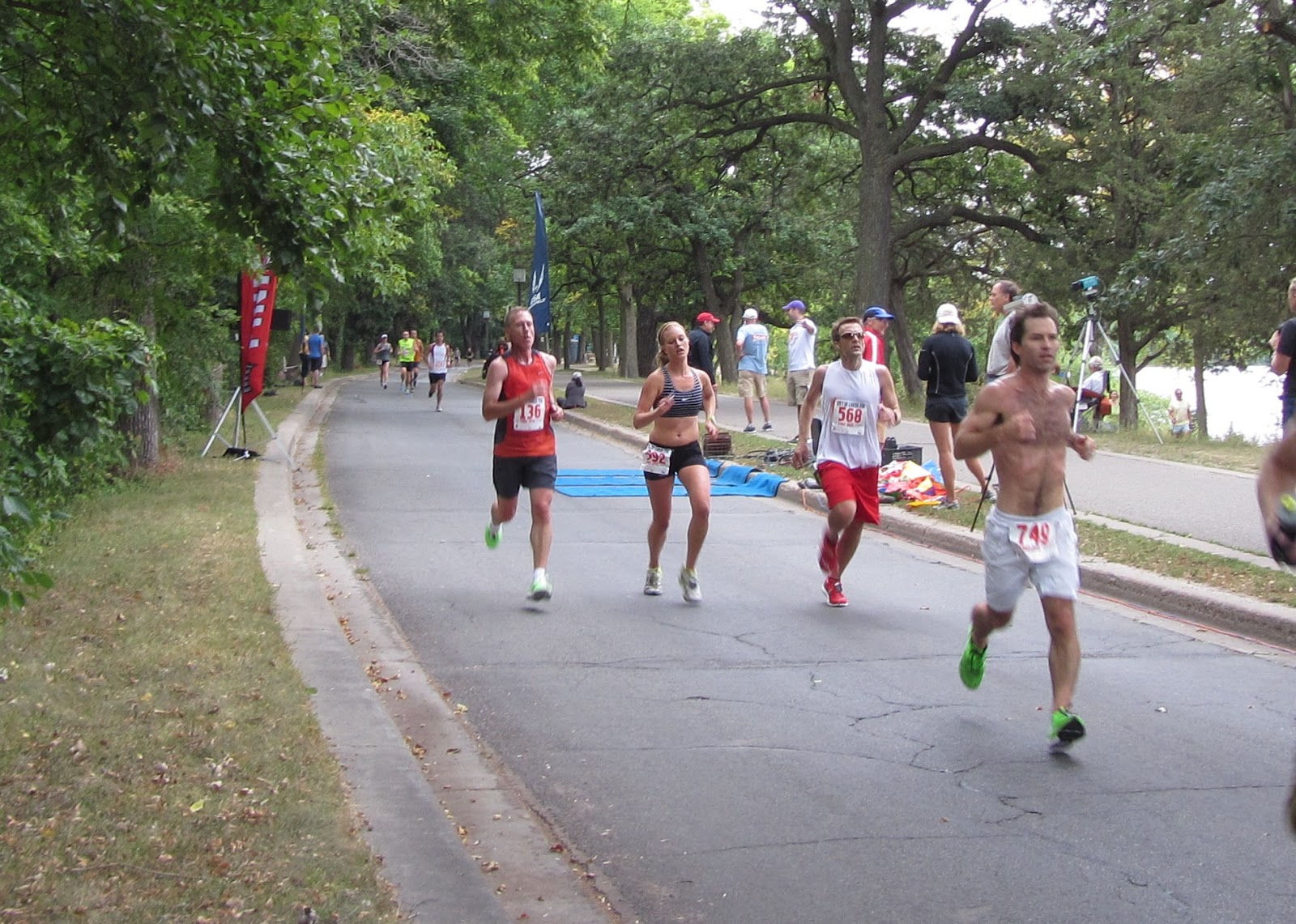
It's been two years since I ran my last marathon and my nerves have now reached peak levels. I always get nervous before every race, but a full marathon puts them on high alert. Not having run a marathon in two years adds a bit of uncertainty as well. It's not just completing the distance that causes my stomach to churn (although that's reason enough). It's knowing I will be soon be pushing through significant physical discomfort for an extended period of time in an attempt to complete the race within a time goal I will have decided upon right before the race begins. Knowing also that after I cross the finish line, the discomfort will linger through most of the day like bad flu symptoms, until my body regains it's appropriate chemical balance again. It's not as simple as pounding down 3 Gatorade's after the race. It takes hours to re-balance again...or at least for me. One might ask...Why do you do it if you don't have to? Good question. Not sure I can answer it in a way that everyone can understand. Part of it is the natural high and satisfaction one receives when achieving something so difficult that very few people can do it - like climbing Mount Everest. It becomes almost addictive in nature. Another factor is the competition itself. Never being satisfied, but always wanting to do better. Your race time is the obvious measurement of success. The faster the time, the better the result. But after running over 70 road races I've come to realize there are other things that define success, or lack thereof in a long race like a marathon. Weather conditions, course difficulty and personal health/injury status all play a huge part in determining your race time. The amount of effort you put into the race isn't always directly proportional to your time, as some of these factors can work against you and all of them must be considered when determining an aggressive but realistic time goal.


My training has gone reasonably well this year heading into the marathon. However, I was dealing with a right achilles issue that caused more nuisance pain than serious injury on many of my runs. I had to put up with it during my high mileage weeks when rest was not an option. I was hoping it wouldn't flair up or throb during the second half of the marathon. The other concern was the weather forecast early in the week that projected temps in the 40's, high winds, with a high probability of rain. Together, all three elements could create the perfect storm for hypothermia in a long race like this. Fortunately, the forecast improved dramatically the day before the race. So much so, that Sunday morning greeted us with absolutely perfect marathon conditions. Temps were in the 40's as predicted, but the winds were calm and the rain actually held off until just after I crossed the finish line. With calm/dry conditions, 40 degrees was exactly what I was hoping for. Knowing the improved conditions, I decided on a time goal for the race which was to finish somewhere in the 3:15-3:20 range, assuming all goes as planned. If it were not for my two year marathon layoff, I probably would shoot for something closer to 3:10 (3:11 is my personal best). But having only run four races so far this year, my confidence level wasn't as high as other years.


The Twin Cities Marathon utilizes the Metrodome as home base the morning of the race. The facility provides adequate protection from the elements and primary restroom facilities. The old dome was built at a modest cost during a time when restroom accommodations were not considered a high priority item in new stadium construction. So lines are always very long and it's best to arrive at least an hour before the race for this reason. Of course the Metrodome will be torn down by this time next year, so I'm not sure yet how the race organizers plan to handle the start of the race next year. They may move it to TCF stadium with a course alteration, or leave the course as is and simply make runners brave the elements without the protection of the dome until the new stadium is completed in four years.


One of the most exciting moments for me at every marathon is the final 10-15 minutes before the start of the race. By then most runners have migrated to the starting corrals and are in the process of peeling off any excess gear worn to provide warmth during the cool morning. Energetic music blares over the loud speakers, while the race announcer provides final instruction with a minute by minute countdown to the start of the race. Finally the national anthem is sung and we are ready to go. I find this window of time very exhilarating and it helps me focus on the task at hand before the horn sounds to start the race. I also find it interesting to do some "people watching" in the corral around me. Everyone has their own rituals they go through before the start of the race. Some completely shut off everything around them and go to their quiet place, while others laugh and joke with those around them about the challenges that lie ahead over the next few hours. Still others play around with their GPS watches to make sure they are getting a clear signal so they can track their pace and mile progress once the race begins. The eyes of the runners tell the real story though. Some eyes overflow with confidence while others reflect fear and wonderment. I'm not sure what mine reflect, but it's probably a combination of all the above. But the time has finally come when all the hours and miles of training will be put to the test. The point of no return as the horn sounds and the mass of humanity begins to roll forward onto the course. You hear the high pitched screeching sound of everyone's electronic race chip registering the start of their individual race as they cross the starting line. Then, the electronic noise quickly fades into the distance, replaced by the steady thumping of running shoes against the pavement all around me.


The early miles of a marathon are always fantastic. Your body feels great, like you can run forever at race pace. The cheers from the spectators provide solid energy and the crowds are nice and thick throughout the "lakes" portion of the course. Everything is fresh, new and invigorating. Despite the cool temps, dehydration is always a concern due to the amount of time on the course and I made it a point to hydrate at every water stop, every other mile right from the start. I've become rather skilled at taking the water cup from a volunteers hand without slowing down and without significant spillage. I then crimp the top of the paper cup with one hand before drinking to ensure the majority goes down my throat rather than allover my face. I only dropped one cup from a volunteer along the way this time. I also chose to bring graham crackers in my running pouch rather than the gels and power bars many like to use, as my stomach tends to get a bit unsettled over the final 6-8 miles of a marathon. Although the nutritional value of a graham cracker isn't comparable to other products, I find them easier to digest and easy on the stomach during a race. I ate a small graham cracker section about every 2 to 3 miles to control the sloshing of water in my stomach while also providing needed carbs for the body to process as the race progressed.


Throughout the first half of the race my pace was steady and consistent. I was averaging a 7:25 mile pace which translates to a 3:13 marathon. The weather remained fantastic with cool temps, calm winds and best of all, no threat of rain so far. I peeled off my gloves at the 8 mile mark. My inner ears often hurt when exposed to windy, cold temps, so I kept my headband on until the 18 mile mark as a precaution to make sure it wasn't going to be an issue for me. The skies which were mostly clear at the start began to give way to cloud cover during the second half of the race. However, I didn't pay much attention to the weather once I reached the half marathon mark as by then, things become much more serious. The early race enthusiasm and excitement gleamed from the spectators gives way to a more focused and intense mindset. The crowds were still there cheering as loud as before, but my awareness of them became less and less. I tend to almost shut down my senses in an effort to conserve and redirect all my energy toward pushing myself as efficiently as possible to the finish line. I totally relax my facial muscles (my wife says I look half dead when I do this) to conserve every ounce of energy I can in hopes it will pay big dividends in the later miles.

As I crossed the 20 mile mark I was still on pace for a 3:14 marathon, but the first signs of trouble began to surface. My quads and hamstrings began to tighten. They weren't cramping, but they became tight to the point that my strides began to shorten by razor thin margins. I was able to maintain the same leg turnover rate, but losing just a tiny amount of stride distance caused my pace to slow about 30 seconds per mile. The slower pace can also be attributed in part to the 3 mile climb up Summit Avenue in St Paul (miles 21-24). The Summit stretch represents the most significant elevation climb during the entire race and at a time when you are least equipped (physically) to handle it. Once reaching the top of Summit Avenue, there are only two miles to go. Among the seven different marathons I've completed, my favorite finish is Twin Cities. With about a half mile to go you pass the Cathedral of St Paul on your left where the State Capital and finish line area comes into view for the first time below. It's a sight for sore eyes as you head downhill for about a quarter mile before leveling off for the last stretch to the finish line. The view of the finish area from the top of the hill provides one last bolt of energy to push you to the finish.

I finished with an official time of 3:17:04. I lost 3 minutes to my pace over the last 6 miles but still ran my 3rd fastest marathon among the 12 I have now completed. Overall, I finished 625th among 8,852 finishers and 13th in my age group of 298 men. I achieved my goal by finishing within the window I was targeting, but as always, a part of me was unhappy that I didn't maintain the 3:14 pace after the 20 mile mark. I now have 3 Twin Cities Marathon's under my belt which ties me with Grandma's Marathon for the most marathons I have completed. The race results page below includes a brief video of my finish. As soon as I crossed the finish line it began to sprinkle, so I grabbed my stuff, connected with my family and headed home as it began to rain heavier. I was very happy to beat the rain and also looking forward to a few days off before resuming my training for a late October 10 mile race in St Paul.
Race Results: