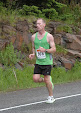
The Big Sur International Marathon was definitely a once in a lifetime experience that I will never forget. We flew to San Francisco on Wednesday, 4 days before the Sunday marathon. Then drove two hours south to Monterey where we spent the majority of our 5 day adventure. Our hotel in Monterey was about 4 miles north of the marathon finish line in Carmel. On Thursday we drove the marathon course to become more familiar with the course and took many pictures along the way. The Big Sur Marathon begins at Big Sur Station which is nestled in the middle of a beautiful mountainous redwood forest. The entire 26.2 mile race follows highway 1 north along the pacific coastline all the way to the finish line at Carmel. The first two pictures (above) show the starting area the day before the race and only provide a glimpse of the beauty in this scenic part of the country.
The Big Sur Marathon is without question the most scenic and beautiful marathon in the country, but is also the most challenging and difficult marathon course you will ever encounter. On race day morning Highway 1 is completely shut down, so the only way to get to the starting line is via official race transportation from the Monterey Conference Center. Runners were instructed to arrive at the conference center by 4:00am. From there we were loaded onto a fleet of buses and driven to the start area. Since the highway was otherwise shut down, spectators were not allowed to drive onto the course, or follow runners along the way. I was glad we drove the course earlier in the week because the entire bus ride to Big Sur was in total darkness. All you could see was a parade of tail lights ahead and headlights behind as the large caravan of buses headed south to Big Sur. As we arrived at Big Sur Station, the eastern skyline was just beginning to show signs of daybreak. The weather was almost perfect. Clear skies, light winds and about 50 degrees. The race was scheduled to begin at 6:45am but started 10 minutes late as it took a bit longer than anticipated to line up the 4,500 marathoners on Highway 1. There was just enough chill in the air that it felt good to get the race underway and begin warming the body as we ran. The first 6 miles were the easiest part of the course because they were predominantly downhill or flat. Mile 1 winds downhill past thousands of large redwoods that lined the highway.


The skies began to turn from black to blue just before the race started, although the sun was still hiding behind the towering hills to our east. At the 3 mile mark we ran through Big Sur Village where many who were staying in the surrounding campgrounds or cabins walked up to the highway to cheer us on. Race officials warned us to add anywhere from 15-20 minutes to our previous best marathon times due to the difficult of the course with its large and continuous hills. After driving the course they didn't have a hard time convincing me of this, so I kept my pace around 7:50/mile in the early going. Not too fast but not too slow since this was the easiest section of the course. At mile 5 we passed the entrance to Molera State Park where we soon began to transition from the forest to the open, grassy pasture land. As we ran through the pastures we encountered many of the "local" spectators (picture - bottom left). Miles 6-8 angled us toward the coast where we got our first glimpse of the Pacific Ocean and Point Sur in the distance (bottom right). Point Sur marks the 8th mile of the race where we connect to the coastline and follow it all the way to the finish line. Very weird for someone from the midwest seeing cows graze near ocean beaches. It was during this stretch to the coastline where we felt the first rays of direct sunlight. Still on the cool side but perfect racing weather with just a light headwind. coastline wind in this part of the country always comes from the north, so significant winds on race day would only mean bad news for marathoners. Fortunately that did not happen. Point Sur also presented us with our first hill of the race. Only a small taste of what was to come.


It was amazing as I took in the ever changing scenery along the way. At the top of the first hill, wild flowers were in full spring bloom and lined the highway on both sides (below). Mile 9 is predominantly downhill and lead us across the Little Sur River bridge and toward the base of the most intimidating hill you will ever encounter in a road marathon. The highway loops inland for a quarter mile across the bridge giving you a perfect view of the difficult climb ahead.


As we crossed the bridge we ran past a group of drummers (below left from last year's marathon) who provided motivation and inspiration (or a distraction from our fear) as we began our 2 mile (520 foot) climb up to Hurricane Point. The 2 miles up to Hurricane Point is a steady climb with some very steep sections along the way. Only one brief but flat 200 yard stretch 2/3's of the way up. Along the way you encounter several turns which (if not familiar with the course) give you the impression you are reaching the summit, only to discover that as you round the bend the road continues to climb on and on and on. Knowing the climb was 2 miles long I made note of my mileage at the base so I could track my remaining distance to the top. Many runners resorted to walk breaks as they climbed, but marathons were made for running and I wasn't about to give in to a mere 520 foot, 2 mile hill no matter how tempting it may have been to walk! The summit provided a breathtaking view of the rocky pacific coast and the beautiful aqua/blue ocean water (below right). The picture doesn't provide you with a good sense of depth but the summit is 550 feet above sea level.


From Hurricane Point you can see the most famous landmark of the Big Sur marathon in the distance 1 mile down the road - the Bixby Bridge (below left). Thepicture to the right looks straight down from Hurricane Point. Iv'e been told that some years the race has encountered 30-40 mph headwinds at the summit which is how the point got its name, however we were fortunate to avoid winds like that, although it was a bit breezy. The one mile descent to the Bixby Bridge was no picnic either. Although downhill, it was a steep descent, dropping 300 feet to the bridge. A real workout for the quads. Again we were warned that most injuries in this race occur on this one mile stretch as runners try to make up for lost time on the climb and run too fast downhill putting too much tension on the joints and quads.


The Bixby Bridge marks the exact halfway point of the race. As you approach the bridge you begin the hear the faint sounds of a piano. Each year concert pianist Michael Martinez plays his grand piano at the north end of the bridge in full tuxedo. A rare and unusual experience hearing a concert pianist in the middle of a marathon along the rugged sea coast. It provided one last diversion as we began the tough 2nd half of the marathon and many hills still to come. None as large as Hurricane Point, but just as tough, if not tougher when fatigue sets in.


The next 6 miles are the most desolate of the race for me and required me to really focus as the hills wanted to wear me down. The first major climb is Rocky Point at mile 17. These miles provide no protection from the sun and although the race temperature never rose much beyond 60 degrees, it began to feel warm in spots where we were sheltered from the ocean breeze. Extended direct sunlight tends to wear me down in marathons anyway regardless of the temperature. With no spectators allowed on the course you are really on your own to motivate yourself mile after mile and these miles definitely made me feel like civilization was hundreds of miles away. Only the rugged coastline and its beauty to keep me company. We ran past Soberanes Point (mile 19) and then began another difficult climb to Yankee Point (mile 22). The transition to Yankee Point began to show signs of civilization again as a few human spectators who live on the coast took time to encourage us as we ran by. Race martial's required us to run the entire race in the ocean side lane so the mainland lane could be used for police on motorcycles and other emergency vehicles. One unexpected challenge was the cant in the road on turns. Much like an oval race track the highway turns were intentionally banked to assist vehicles around tight corners. This was the case throughout the coastline section of the race, but as the race wore on and fatigue set in I found myself drifting down the embankment and at times having difficulty maintaining my line.


As we ran from Yankee Point to Point Lobos (mile 24), the number of spectators began to swell as we approached Carmel. High school bands popped up here and there, along with other roadside entertainment like the "Strawberry Lady" and her table of huge fresh strawberries. A few belly dancers came out of nowhere as they wandered onto the course becoming more obstacle than entertainment. After conquering another hill, the stretch from Point Lobos to mile 25 was mostly downhill thankfully. Just one mile to go but also one last hill to conquer. A half mile climb that was straight as an arrow heading into Carmel. I could taste the finish line but desparately wanted to run around the hill. It felt like a dirty trick played by an evil race director. As I reached the top of the hill there was only one-half mile to go and it was all downhill! I could see the flags of different countries along the side of the highway and the big orange (inflated) arch that represented the finish line. Spectators lined both sides of the road as we approached the final 100 yards. The marathon was the main event Sunday morning but there were also several other shorter races affiliated with the marathon that used Highway 1 and finish area also. As a result there were many walkers/runners completing their events and heading down the final stretch with me. The picture (below left) was with 200 yards remaining and the one on the right with 100 yards to go.


Like every marathon, there is a sense of relief when you cross the finish line knowing it's over and you successfully completed the race. After running for over 3 hours it feels very strange - almost difficult to walk. After each marathon I begin to realize how spent I am from head to toe. Celebrating the accomplishment comes later in the day. My first priority is to rehydrate and finding something along the post race fruit/snack tables that looks appealing to eat and won't upset my stomach.
My official time was 3:38:16. Just 13 minutes shy of my personal best and about 5-7 minutes faster than I expected to run considering the course. Overall I finished 304 out of 3,448 finishers and 26th of 219 in my age group. Based on the 4,500 runners who entered the race, the course apparently took its toll on many who were unable to make it to the finish line. I have many memories and stories of which I won't go into now, but I definitely recommend this race to any marathon runner looking for an experience they will never forget!
https://www.runraceresults.com/secure/raceresults.cfm?ID=RCLJ2010